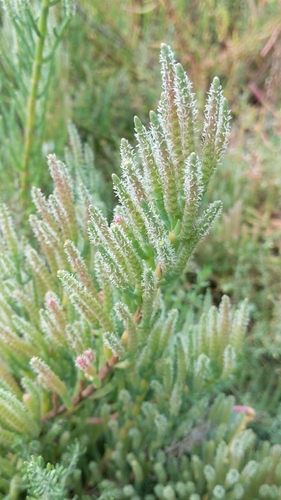
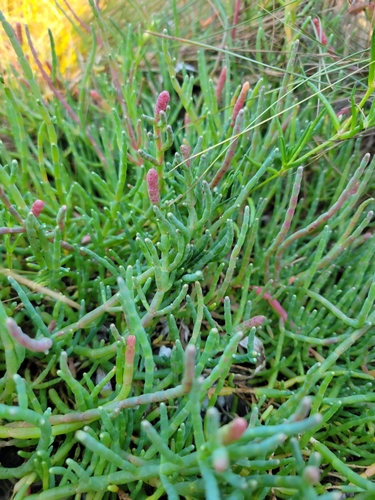
American Glasswort
Salicornia pacifica
Care
full sun
moderate
Fast, Standing; Usually found in saturated, sandy soil.
0–2ft tall
Jun-Nov
Friendly
Succulent stems eaten raw or pickled; salty vegetable
Salt marshes and alkali flats of coastal California from Humboldt County to Orange County, below 100 ft elevation.
Care Guide
Planting
Plant American Glasswort in full sun in fast-draining or standing water soil - it naturally thrives in saturated, sandy conditions like salt marshes and alkali flats. Space plants to accommodate their mature height of 1–2 feet. Plant in spring or early summer to establish before the growing season.
After Planting
Water moderately to heavily during the first growing season; this plant naturally occurs in wet environments and needs consistent moisture to establish. Once established, American Glasswort requires less intervention - it's adapted to thrive in conditions most garden plants find challenging. The main mistake is underwatering: treat it like the wetland plant it is, not a drought-tolerant succulent. Expect summer and fall blooms once settled in.
Visit Calscape for more information about American Glasswort
Endangered & Threatened Species Supported
California Clapper Rail subspecies; federally and state endangered
Salt marsh harvest mouse federally and state listed as Endangered
Grasshopper Sparrow; California-listed as threatened
Western Pygmy Blue butterfly; California species of special concern
Wildlife Supported
Mammals
Primary food source in coastal salt marsh habitats; critical winter survival food
Birds

Forages in dense Salicornia mats for invertebrates; plant provides nesting cover and shelter

Nests in salt marsh vegetation including Salicornia stands; breeding season April-August

Grazes on Salicornia shoots during migration and overwintering in coastal marshes
Insects

Multiple generations per year in California coastal marshes; larvae feed on succulent stems and leaves

Herbivorous beetle that feeds on succulent halophytic vegetation in coastal marshes

Hunts small arthropods on Salicornia stems; indirect relationship through prey species

Parasitic plant that feeds on Salicornia; supports herbivorous insects that feed on dodder-infected plants