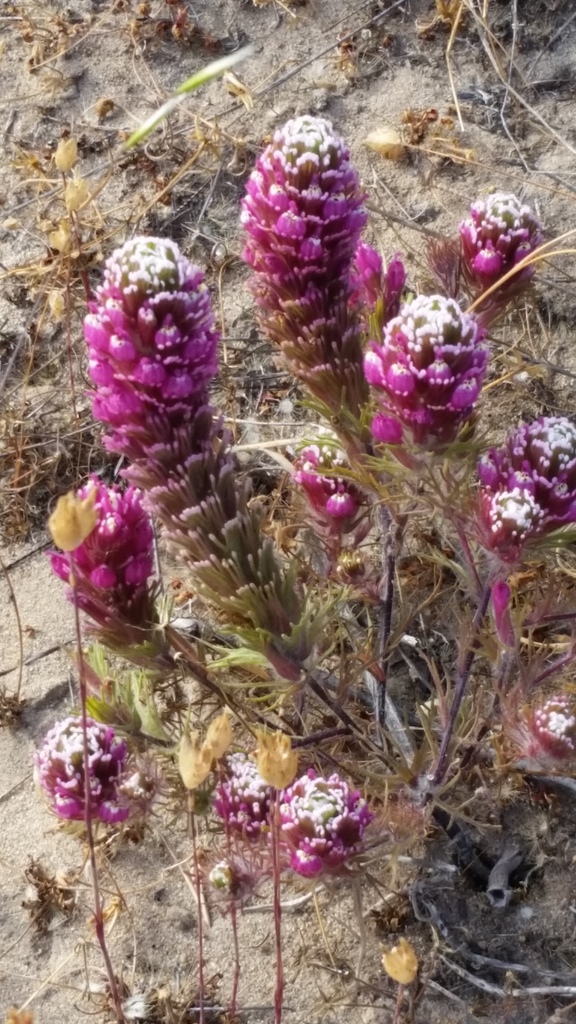
Exserted Indian Paintbrush

Castilleja exserta subsp. exserta

Care
Sun

full sun

Water

very low

Soil

Fast, Medium, Slow; Tolerant of sand and clay, prefers fast-draining soil.

Size

2–2ft tall, 1–1ft wide

Bloom

Mar-May

Deer

Resistant

Container

Friendly

Flowers

Prized

Native Range

Coastal grassland and scrub from Sonoma County south to Kern County, primarily below 2000 ft elevation

Care Guide

Planting

Plant your Exserted Indian Paintbrush in full sun with fast-draining soil; it tolerates sand and clay but prefers good drainage. The critical step: plant it alongside a native perennial grass or other host plant from its natural community, since this species derives nutrients directly from neighboring plant roots and won't thrive alone. Plant in fall or early spring to establish before summer arrives.

After Planting

This is a low-maintenance annual once established - it needs no summer water and is very drought-tolerant. The #1 mistake is planting it without a companion host plant; without one, it will struggle or fail entirely. Your plant will flower March through May and won't require pruning or fussing; just let it grow naturally in its meadow-like setting.

Visit Calscape for more information about Exserted Indian Paintbrush

Endangered & Threatened Species Supported
Bayensis checkerspot butterflyEuphydryas editha bayensis

Federally endangered since 1967; restricted to serpentine grasslands in Bay Area

Federal: Endangered, CA: Endangered
Edith's checkerspot butterflyEuphydryas editha

Some subspecies federally protected; species has state endangered designation

CA: Endangered
California ringlet butterflyCoenonympha california

California state threatened species

CA: Threatened
Chalcedon CheckerspotEuphydryas chalcedona

California Species of Special Concern

CA Special Concern
Wildlife Supported

Insects

Larval Host · Spring

critical larval food plant for caterpillars in spring emergence

Larval Host · Spring

primary host plant for larval development

Nectar · Spring

early spring nectar source for emerging adults

Nectar · Spring

early season nectar source for queen establishment

Larval Host · Spring

host plant for spring broods

Nectar · Spring

pollen and nectar source for diverse bee species

Nectar · Spring

primary spring foraging resource

Larval Host · Spring

larval food plant

+5 more species

Birds

Nectar · Spring

early spring nectar source for migrating hummingbirds

Where to Buy
Native Here Nursery

101 Golf Course Dr, Tilden Regional Park, Berkeley

Sat 10am-2pm

3.0 mi(510) 549-0211WebsiteDirections