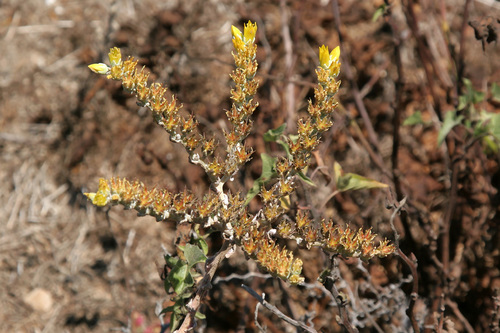
Santa Barbara Live-for-ever
Dudleya traskiae
Care
part shade, full sun
very low
Fast, Medium; Occurs on a variety of soils ranging from loamy to gravelly or rocky and clay.
0–0ft tall , 0–1ft wide
Jan-Dec
Evergreen
Resistant
Friendly
Leaves eaten raw or cooked; succulent leaves traditionally used
Santa Barbara Island off the coast of Santa Barbara County, endemic to this island location.
Care Guide
Planting
Plant Santa Barbara Live-forever in full sun or partial shade in fast-draining to medium soil - it thrives in loamy, gravelly, rocky, or clay soils as long as water moves through quickly. Space rosettes at least 6–12 inches apart to allow room for the plant's branching growth. Fall through early spring is ideal planting time in the Bay Area. If you're growing in a container (this plant does well in pots), use cactus or succulent potting mix to ensure excellent drainage.
After Planting
Water weekly during the first summer after planting, then taper off - by the second year, established plants need water only about once per month in summer or less. Never let the soil stay wet; this is the #1 killer of this succulent. Once established, Santa Barbara Live-forever is nearly maintenance-free and requires minimal pruning. Expect bright yellow flowers from February through July, with peak bloom in May–June.
Visit Calscape for more information about Santa Barbara Live-for-ever
Endangered & Threatened Species Supported
Endemic to San Clemente Island; fewer than 100 individuals remain
Wildlife Supported
Insects

Specialist herbivore adapted to succulent leaf tissues
Dense leaf rosettes provide refuge for invertebrates
Birds

Forages on arthropods inhabiting plant tissue and leaf axils
Reptiles

Rosette structure provides microhabitat and thermal refuge

Uses dense rosettes for cover and basking sites

Uses rosettes as daytime refuge during breeding season