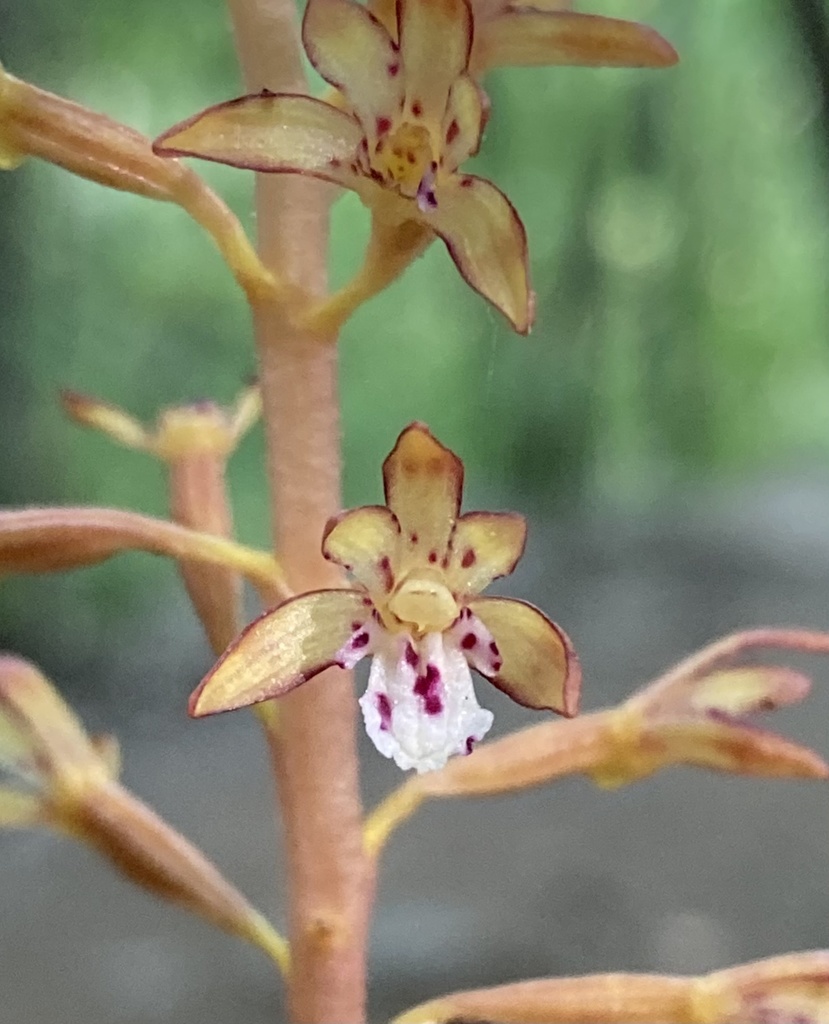
Spotted Coralroot
Corallorhiza maculata
Care
part shade
2–2ft tall
Friendly
Throughout California in mixed conifer forests, oak woodlands, and riparian areas from sea level to 9000 ft elevation, extending north to British Columbia.
Care Guide
Planting
Plant your spotted coralroot in partial shade, ideally in an area with decomposing leaf litter that mimics its natural forest habitat. This orchid is a mycoheterotroph, meaning it depends on fungi in the soil to survive - it has no chlorophyll and cannot photosynthesize. The most critical factor is ensuring the soil contains the right fungal partners, which are naturally present in rich woodland settings with decaying organic matter.
After Planting
After planting, maintain the leaf litter layer and avoid disturbing the soil around the plant, as this protects the fungal relationships your coralroot depends on. There is no information available on watering, pruning, or specific establishment care for this species in cultivation. This is a wild orchid, not a typical garden plant, so expect it to behave like the woodland native it is - potentially dormant for parts of the year and difficult to establish outside ideal conditions.
Wildlife Supported
Insects
Specialist fungal pathogen host-specific to Corallorhiza maculata tissues
Host-specific fungal disease agent on coral root orchid
Spring foragers attracted to floral nectar resources
Beetles feeding on pollen during flowering season
Small flies visiting flowers for pollen and nectar
Early spring foragers collecting pollen provisions for nesting
Visits flowers during peak blooming period for nectar and pollen resources